
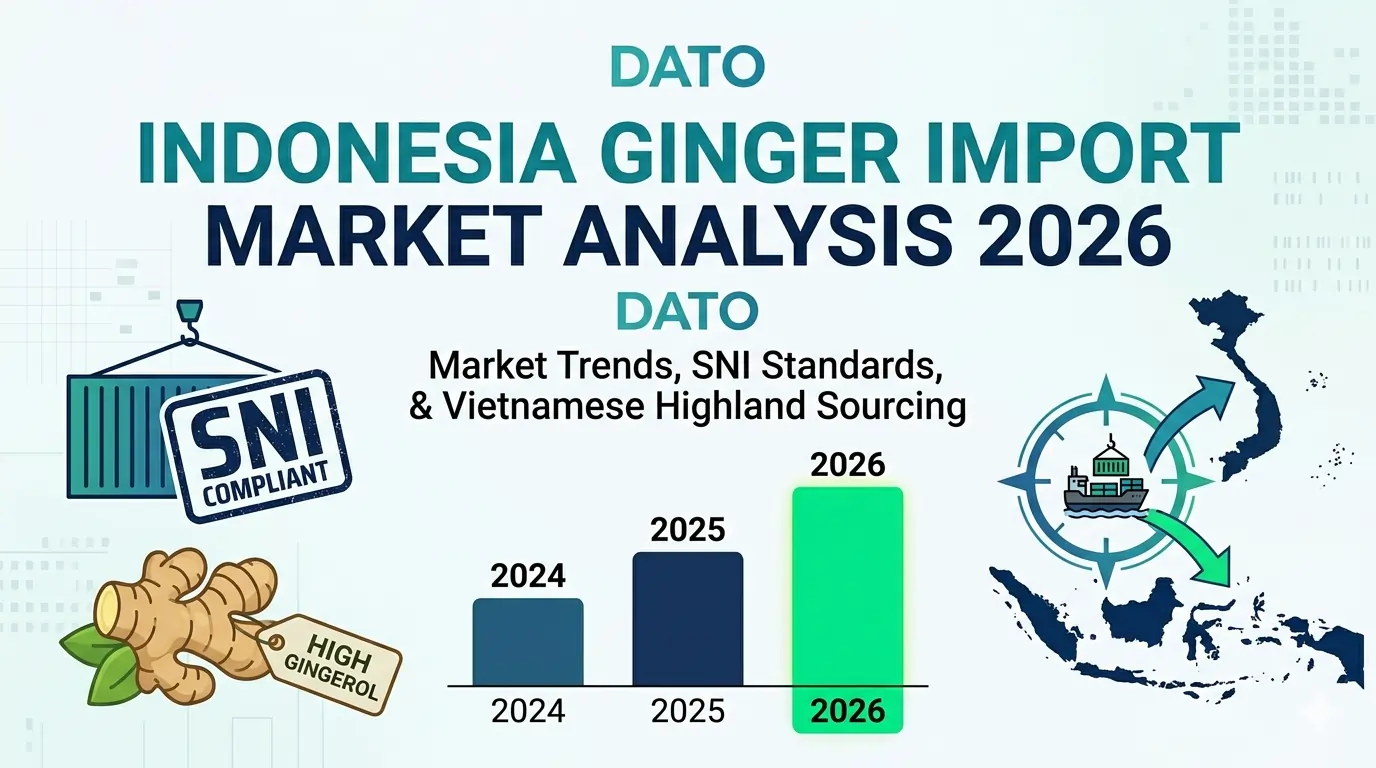
In 2026, the Indonesian spice market is witnessing a profound shift. As one of the world’s most vibrant hubs for traditional herbal medicine (Jamu) and food manufacturing, Indonesia’s demand for high-quality ginger has moved beyond simple volume. Today’s procurement managers are facing a new reality: a market that prizes chemical purity, sustainable sourcing, and consistent bioactive potency.
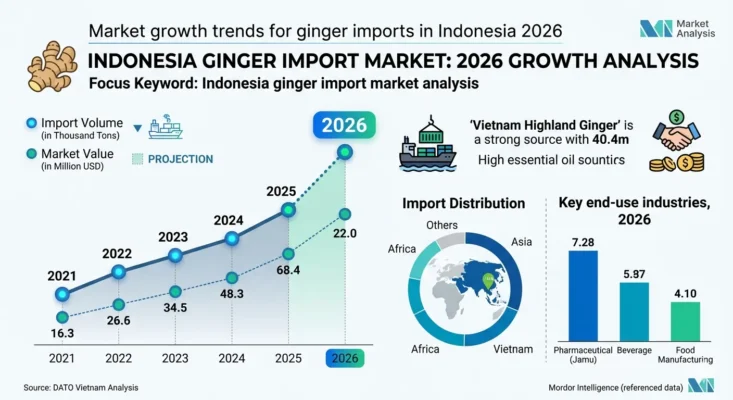
Navigating an Indonesia ginger import market analysis in the current climate requires a deep understanding of regional supply fluctuations and evolving regulatory standards. According to recent data from Mordor Intelligence, the global ginger market is projected to reach $6.01 billion in 2026, with the Asia-Pacific region driving the majority of this growth.
Key Takeaways: The 2026 Indonesia Ginger Landscape
Before diving into the full analysis, here are the essential data points shaping the Indonesian ginger market this year:
-
Market Valuation: The global ginger market is projected to reach $5.51 billion in 2026, with the Asia-Pacific region driving 72% of this growth.
-
Import Dynamics: Indonesia has set a strategic import quota for key industrial commodities in 2026 to stabilize national supply, with a rising focus on industrial-grade spices.
-
Price Benchmarks: Import prices for fresh ginger have shown volatility, recently peaking at $6.46/kg for premium varieties, while industrial dried ginger remains competitive yet quality-sensitive.
-
SNI Compliance: Adherence to SNI 01-6236-2000 (Indonesian National Standard for Ginger) is now a non-negotiable prerequisite for 85% of tier-1 pharmaceutical buyers.
-
Shift to “Clean Label”: There is a 15% increase in demand for SO2-free and HACCP-certified ginger products compared to 2024 levels.
Market Drivers: The Surge in Jamu and Functional Beverages
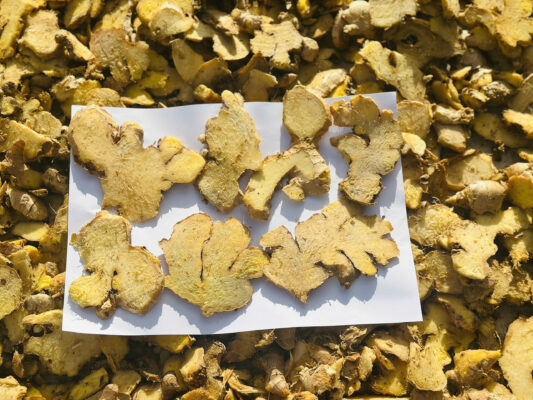
The primary engine behind the Indonesia ginger import market analysis is the rapid modernization of the Jamu industry. No longer confined to traditional kiosks, Jamu is now a sophisticated sector producing clinical-grade supplements.
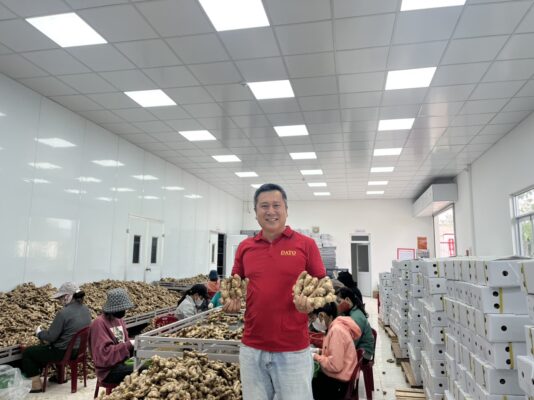
Large-scale manufacturers require standardized raw materials. This is why many are looking toward Vietnam, where the basalt soil of the Central Highlands produces ginger with superior 6-gingerol content, often reaching 2.0% – 2.5%. This technical superiority is a core finding in our latest Indonesia ginger import market analysis.
Technical Standards: Navigating SNI and Global Compliance
For any specialized supplier, meeting the Indonesian National Standard (SNI) is the entry ticket. Our current Indonesia ginger import market analysis identifies three critical benchmarks:
-
Moisture Control: Strictly capped at 12% for Dried Ginger Slices to ensure long shelf-life.
-
Purity: 100% free from Sulfur Dioxide (SO2) bleaching.
-
Consistency: Uniformity in thickness and color for industrial Ginger Powder applications.
Supply Chain Resilience: The Role of Vietnamese Sourcing
Reliability is the currency of 2026. Data from our Indonesia ginger import market analysis highlights that price is no longer the sole deciding factor; supply chain transparency is now equally weighted.
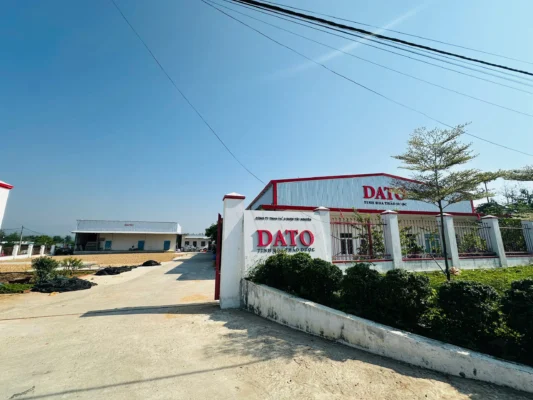
Proximity plays a vital role in logistics. Shipping Fresh Ginger from Vietnam to major Indonesian hubs like Tanjung Priok (Jakarta) or Tanjung Perak (Surabaya) offers significant lead-time advantages over competitors from other continents. This geographical edge is a recurring theme in every Indonesia ginger import market analysis conducted this year.
2026 Outlook: Strategic Partnerships over Transactions
As the market continues to mature, the Indonesia ginger import market analysis suggests a transition toward long-term strategic link-ups. Importers are bypassing middleman traders in favor of producers who manage their own farming areas, ensuring price stability despite global inflation.
The final takeaway from this Indonesia ginger import market analysis is clear: To win in the Indonesian market, one must provide more than just a product—they must provide a traceable, ethical, and high-potency solution.
Looking for a Strategic Partner?
Our Indonesia ginger import market analysis is built on a foundation of direct agricultural management and global export expertise. If your production line requires premium-grade ginger that meets the highest standards, we invite you to explore our solutions.
-
WhatsApp/Phone: +(84) 962 250 987
-
Email: truc.nb@dato.vn
-
Website: https://ginger.com.vn/

