
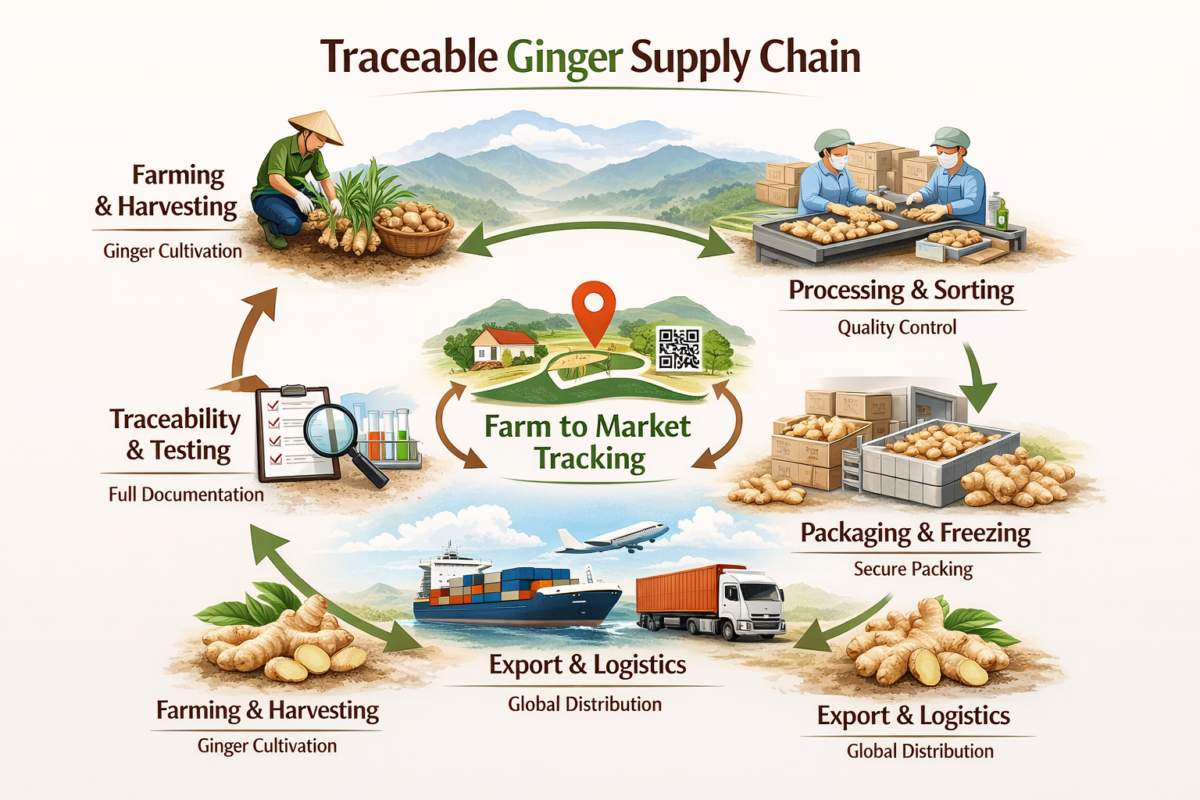
In today’s global agricultural trade, transparency and product safety have become top priorities for international buyers. As a result, building a traceable ginger supply chain is increasingly important for ginger exporters who want to access demanding markets such as the European Union, the United States, South Korea, and the Middle East.
A reliable traceable ginger supply chain ensures that every stage of production from cultivation and harvesting to processing and export can be monitored and verified. This transparency helps importers guarantee product safety, maintain quality standards, and build trust with consumers.
Why Traceability Matters in the Ginger Industry
The global spice market has undergone significant changes in recent years. Buyers are no longer focused solely on price and quantity; they also require transparency and responsible sourcing.
A well-managed traceable ginger supply chain provides several key advantages:
Clear identification of the origin of raw materials
Compliance with international food safety regulations
Improved quality control throughout the supply chain
Increased trust between suppliers and global buyers
For food manufacturers and importers, traceability reduces risks related to contamination, pesticide residues, and inconsistent product quality.
Key Components of a Traceable Ginger Supply Chain
Building a reliable traceable ginger supply chain requires coordination between farmers, processors, exporters, and logistics partners. Several key elements must be in place.
1. Traceable Farming Practices
The foundation of any traceable ginger supply chain begins at the farm level. Farmers must follow standardized cultivation practices and maintain records of planting, fertilization, and crop protection methods.
This allows exporters to provide buyers with detailed information about the origin and growing conditions of the ginger.
2. Controlled Processing Systems
After harvest, ginger must be processed in hygienic facilities that follow strict quality management procedures. Washing, peeling, slicing, drying, or freezing must all be carefully monitored.
A well-organized traceable ginger supply chain ensures that each batch of ginger can be tracked from raw material to finished export product.
3. Transparent Documentation
International buyers often require detailed documentation to verify product origin and processing standards. A complete traceable ginger supply chain includes proper labeling, batch coding, and export documentation that allows products to be traced quickly if necessary.
The Role of Sustainable Farming Communities
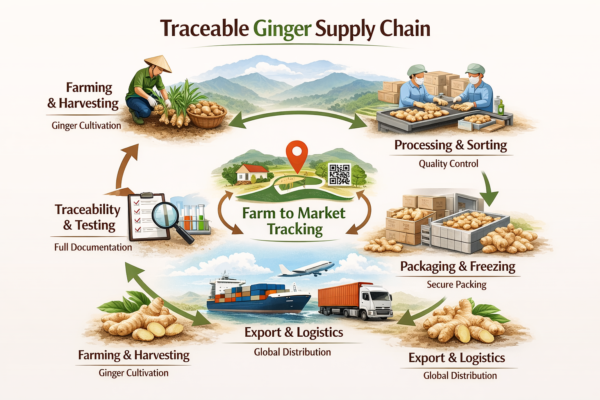
Many ginger-producing regions rely on smallholder farmers. By organizing farmers into structured supply networks, exporters can improve both traceability and sustainability.
A strong traceable ginger supply chain helps ensure:
Stable income for farming communities
Responsible agricultural practices
Long-term supply stability for global markets
This model benefits both international buyers and local agricultural communities.
Vietnam’s Growing Role in Traceable Ginger Supply
Vietnam has become an increasingly important supplier in the global ginger market. Favorable climate conditions, fertile soils, and experienced farming communities make the country well suited for ginger cultivation.
In recent years, Vietnamese exporters have focused on strengthening their traceable ginger supply chain to meet international market expectations.
By combining traditional farming knowledge with improved agricultural management and modern processing systems, Vietnam is building a more transparent and reliable ginger export industry.
DATO – Supporting a Traceable Ginger Supply Chain
One example of this approach is DATO, a Vietnamese agricultural enterprise located near the Ngoc Linh Mountain region in the Central Highlands.
The company works closely with over 500 farming households, many of whom belong to ethnic minority communities, to cultivate ginger and other agricultural products under controlled and traceable conditions.

Through training, stable purchasing programs, and close monitoring of farming practices, DATO helps strengthen a traceable ginger supply chain that supports both product quality and sustainable livelihoods.
This model allows international buyers to access ginger products with reliable origin information and consistent quality standards.
The Future of Traceable Ginger Supply Chains
As global consumers continue to demand transparency, sustainability, and food safety, the importance of a traceable ginger supply chain will only increase.
Exporters who invest in traceability systems, responsible sourcing, and transparent documentation will be better positioned to serve international markets and build long-term partnerships.
Vietnam, with its growing expertise in agricultural exports and sustainable supply networks, is well placed to play a larger role in the future of the global ginger trade.
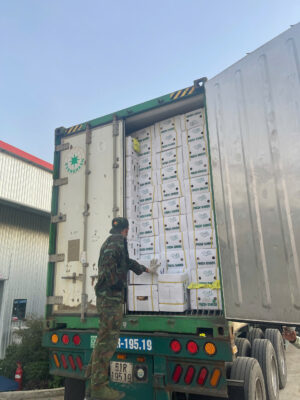
📩 For more information about traceable ginger sourcing, product specifications, and export opportunities, buyers can contact DATO directly for further details.

